Read the latest theatre reviews for must-see Manchester shows at 101Frances
Search this site
280 results found with an empty search
- Precarious Carnaval | Manchester
Precarious Carnaval has plunged into the past, present and future to unearth the secrets of the Bridgewater canal. Celebrating its 258th birthday, artists Lowri Evans, Renato Bolelli Rebouças and Rodolfo Amorim are helping audiences embark on a journey through the history of England’s first canal. The award-winning theatre-makers from Brazil and the UK have collaborated in a community event that fuses over thirty local groups and hundreds of volunteers. Creating a crafty collection that captures Salford’s hidden history, the immersive three acts flow through three days of events. Offering a time travelling trip back to 1761 when the canal was first commissioned by Francis Egerton 3rd, the carnaval trail from Boothstown Marina to Worsley’s Humpback Bridge captures how the channel enabled a more efficient production of coal. The carnaval walk-through celebration explores how the process of the industrial revolution moved people out of the field and into factories but exposes how its challenging history was fuelled by the hard labour of miners and funded through slave labour. Haunting us like Marley’s ghost, the spirits of the mine workers roam the tumultuous trail that intertwines the colourful festivities with the forgotten voices sacrificed in the pursuit of progress. Explaining how race, class and gender exploitation energised the industrial revolution, the path positions real and fictional characters to explore where this route will lead us in the future. Atop the Queenie narrowboat, a drunken woman sings about her lost youth and her sealed fate as a poorly paid 7-year-old coal miner. But these scenes are pinned against a life-size ice cream mascot and the entangled Smith’s Knits mermaids washed ashore, covered in the discarded rubbish that has been thrown in the canal by passers-by. It is a uniquely designed, family-friendly affair that ensures that these stories are digestible for its younger audience. Including music, witches and mermaids placed along its route to keep the atmosphere imaginative and entertaining, the installations and characters are all beautifully illustrated against the natural scenic route. The vibrant festival even takes a minute to take cover under a bridge where a masked ball accompanied by a brass band awaits anyone willing to don a disguise and drink with the devil. Comprised of countless local acts including an original poem from the Bridgewater Youth Centre and the Barton Belles performance of The Ship Song (by Nick Cave & The Bad Seeds), the picturesque walkways are lined with visual and creative collections of public art. Precarious Carnaval allows audiences the opportunity to watch and take part in a candid celebration surrounding the Bridgewater Canal. Flooded with history, it does not offer a nostalgic walk down memory lane, but instead represents the positive and negative impacts of the privately-owned canal and the industrial revolution. Confronting the idealism of a new world, the show explores how the past has encouraged our present use of dirty energy and exploitation whilst also driving modern developments and new scientific discoveries.
- A Streetcar Named Desire Review | Royal Exchange | Manchester
Who knew a descent into madness could be leveled with humor? Manchester’s Royal Exchange welcomes Maxine Peake back with open arms. After playing the lead in 2015’s Hamlet, Peake has returned as the equally convincing and beaten down Blanche in A Streetcar Named Desire. Blanche arrives in New Orleans to stay with her younger, pregnant sister Stella and her partner Stanley. Stella’s squalid one-bedroom apartment is a love shack in her eyes but a distressing downgrade to Blanche who is used to her and her sister picking the finer things in life. Fortunately, nowadays Blanche lives mostly in her head, and the lack of space is only an issue for her brother-in-law, whose presence helps bring Blanche back to the reality of her current situation. Stella’s sparse apartment is depicted onstage with two mattresses, a mini fridge fixed with gin and a bathroom separated off by a sheet of two-toned glass. The panel is often used to reflect Stella’s polished persona to the audience as she preens herself and unwinds in the bath. However, the glass also clears to reveal her demons, and fantasies as they walk amongst the audience as unsettling and tangible characters. Director, Sarah Frankcom allows the audience to have a direct connection to Blanche. The events are generally viewed through her eyes, with the cramped, unpolished conditions mirroring the intense visions in her head. The cast mainly feature as props to sustain Blanche's fantasies. However, Blanche’s sister, played by Sharon Duncan-Brewster and Ben Batt (Stanley) have an intriguing rapport which helps to convince the audience of Brewster’s conflicting love for both her sister husband. Although the dresses are modern, the southern accent remains in this tender retelling of Streetcar. It is visually haunting and delicately cast production that will leave a lasting impression on its audience. #AStreetcarNamedDesire #Manchester #TheRoyalExchange
- The Night Watch Review | The Royal Exchange | Manchester
“I thought everything would change, after the war. And now, no one even mentions it. It is as if we all got together in private and said whatever you do don’t mention that, like it never happened.” The Night Watch is an understated and beautifully performed story that portrays five characters during 1947 to 1941. This WW2 same sex love affair is written by Sarah Waters and adapted for the stage by Hattie Naylor. By revealing its narrative in reverse the story slowly exposes its interlinking characters and their transformations surrounding and during the war. Built on loss, sacrifice and regret, the only nostalgia for the period is in the job opportunities the war established for women. Kay, played by Jodie McNee first appears to be the self-assured heroine of the piece. An emergency operator during the war, she appears dressed in a mannish suit, a cropped hair cut, with a cigarette behind her ear. When Kay speaks you realise that years have passed since the war but she remains exhausted by the horrors she has witnessed. She spends most of her days at the cinema, suddenly visibly restless and dazed. The characters are connected by the part they played in the war and by the suppression of their sexuality. The Royal Exchange is transformed by Rebecca Gatward’s and Georgia Lowe’s direction and design. The rewinding timeline is paired with a revolving circular stage and minimalist props that let the audience focus on the intense restoring of each characters layered connection. The spirit of simple pleasures in their tragic, war-torn lives is carried by the perfectly absorbing cast. Set on the dizzying waltzer which is life and subtly portray at the Exchange. #TheNightWatch #Manchester #TheRoyalExchange
- Into The Woods Review | The Royal Exchange | Manchester
“The woods are just trees; the trees are just wood.” The Royal Exchange sends its audience skipping Into the Woods with a contemporary revival of the Stephen Sondheim 1986 classic. When a wicked witch places a curse on a childless baker and his wife; the couple blend fables to find various fairy-tale characters recognisable items to form the ingredients for their baby. The realistically revamped fairy-tale interweaves characters from Little Red Riding Hood, Jack and the Beanstalk, Rapunzel and Cinderella for an offbeat musical that deals with themes of loss, betrayal, and death. Olivier and Tony-winning designer Jenny Tiramani create an encroaching forest that surrounds the famously round theatre. With a narrator sitting amongst the audience and an eight-piece band filling in live sound effects, the production takes advantage of the enclosed space. It surprised its audience with characters appearing from all four entrances and levels of the theatre (as well as suspended in mid-air) to keep the play lively and engaging. The story offers the best of both worlds. Act 1 invigorates its audience with well-known characters’ stories. Portrayed by a strong cast of eighteen, including Alex Gaumond as the Baker and Amy Ellen Richardson as his wife. Gillian Bevan as the Witch and Exchange Associate Artist Maxine Peake as the voice of the Giant. Act 2 looks at the reality of what characters have done to achieve their wishes and how they have affected their entire kingdom. Asking, what happens after "happy ever after" in the real world? Into the Woods is far from a preachy children’s story, its subtext is a lascivious and subversive look into classic fairy-tale characters. #IntotheWoods #TheRoyalExchange #Manchester
- The Emperor Review | Homemcr | Manchester
"Power tends to corrupt, and absolute power corrupts absolutely." Sir John Acton The Emperor is a story filled with disenchantment, offering a glimpse at the descent of power through the eyes of the powerless. The fall of the Ethiopian empire is exposed through ten characters, all played by Kathryn Hunter. Capturing the rituals and extravagance of everyday life for Haile Selassie are the civil servants surrounding him. Kathryn switches between ten male roles including the emperor’s dog cleaner, time-keeper, pillow bearer and Minister of Information. Paired with Ethiopian musician Temesgen Zeleke, who performs live on stage besides Kathryn. Kathryn displays her versatility by transforming through costumes, voices and mannerisms effortlessly. The simple, black set and swift costume changes allow the audience to follow Haile Selassie’s dethronement in a removed, entertaining but ultimately moving performance. Running alongside the loyal cast of characters is Jonathan Dimbleby’s documentary, The Unknown Famine. The TV documentary brought light to Ethopia’s famine in 1973, with its exposure and embarrassment used to fuel the overthrow of Selassie. The deterioration of everyday life plays out slowly for the people of Ethiopia. Distraction techniques are used to motivate people against their own self-interests and many of the authoritarian practices are still prevalent in western culture. Kathryn even brings audience members up onto the stage to party and enjoy the Ethiopian empires new riches. All of Kathryn’s characters eventually serve to highlight the desperate state of the declining Selassie regime with the inevitable corruption of power. Their servitude allows them to watch their country drained of its resources and its people starve whilst its emperor stashes $100 bills under his Persian carpet. #TheEmperor #Manchester #HOMEmcr
- Coronavirus (COVID -19)
When it comes to outstanding theatres and memorable productions, Manchester is spoilt for choice. However, the recent suspension of all performances has left the future of our theatres in peril. Help support Manchester’s theatres and performers through the Coronavirus pandemic by donating or gifting the price of your ticket back to the theatre. The Lowry https://wonderful.org/fundraiser/emergencyappealtosupportthelowry-de4579b3 HOMEmcr https://homemcr.org/about/support/donations/ The Royal Exchange https://www.royalexchange.co.uk/we-need-your-support ATG https://www.atgtickets.com/membership/ #SupportTheArts #noplacelikeHOME
- WTF Missy Elliott
Missy Elliott’s latest music video 'WTF' (Where They From) has been released on YouTube from her upcoming 7th album. It has been 10 years since Missy’s last studio album, 'The Cookbook' was released but the hit maker is back with a vengeance. The Grammy winning rapper turned her attention to producing when she was diagnosed with a disorder known as Graves' disease, which at times left her unable to write. Missy opened up about her diagnosis on Sway In The Morning in 2012 claiming, "For me, when you say you have to take a radiation pill you think you’re really finna be out of here…You have to go through your eyes changing, your hair falling out and skin changing. Everything for me was traumatic." With a career spanning over 20 years, 'WTF' will be Missy’s first new single since 2012. Despite this, Missy has featured on numerous songs since her hiatus, including 'Without Me' with Kelly Rowland and Fantasia in 2013. As well performing a medley of her hits at the 2015 Super Bowl XLIX halftime show with Katy Perry. Fans are now ecstatic to see one of the first ladies of hip-hop get back to her roots and return on full form. 'WTF' features Pharrell Williams, fresh choreography and the unforgettably cinematic scenes Missy is known for. This article was originally written for The Nubian Times
- The Hateful 8
‘When you get to hell, John, tell them Daisy sent you.’ Tarantino continues to re-write history with this self-referential Reservoir Dogs of the West. Taking place some time after the American Civil War, eight strangers comprising of outsiders, bounty hunters, former Confederates and a prisoner are forced to take shelter in a remote cabin as a fierce blizzard runs through. The ultra-wide, 70mm shot scenes capture the vast landscape and hostile environment but chiefly offer an intimate look at the characters within Minnie’s Haberdashery. Tarantino re-evaluates America history in this anti-western as he refuses to romanticise whiteness or its failed depictions of American masculinity. Bruce Dern and Samuel L. Jackson both play veterans with conflicting and sometimes mythological notions of what part they played in the war. There are no boundaries to the misogyny, racism and callous disregard for his characters and despite the three main stars all being in their 50’s, Tarantino doesn’t pull any punches. The Hateful Eight includes the first original score for a Tarantino film, composed by Ennio Morricone who went on to win the Golden Globe for Best Original Score. The film is also teamed with an experienced cast who offer great performances. Samuel L. Jackson, Kurt Russell, Jennifer Jason Leigh, Walton Goggins, Demián Bichir, Tim Roth, Michael Madsen, and Bruce Dern all boost the character driven film. Tarantino’s universe continues to merge his love of history with contemporary themes of racism and violence that is not without its monologues and shock value scenarios. The Hateful Eight, however, has a wider dialogue in regards to issues of class, ethnicity and gender. They are not elaborate, judgmental or resolved, but they are genuine concerns. The six-part western revival reads like a play. It underpins racial politics and contemporises the issues that will resonate with its intended audience. Despite the film being 3 hours 7 minutes long, during the AMC’s first screening of the film, the room shows no signs of popcorn or phone lit faces. The filmmaker's self-proclaimed 8th film is very much representative of his style and yet still relevant and suspenseful.
- Review: I Must First Apologise…
Since 1999 artists Joana Hadjithomas and Khalil Joreige have collected over 4,000 scam emails. In their new exhibit, I Must First Apologise… the artists explore why scam emails are still effective and what they say about the state of the world today. The fraud, known as the Nigerian scam (due to the bulk of the cons originating from the country) predates email. While the tricks have been extremely effectively in manipulating thousands of people into giving up their savings, it has at worst resulted in bankruptcy, murder and suicide. Ordinarily, both the victims and perpetrators of these deceptions remain anonymous. Hadjithomas and Joreige make the scams concrete, using sculptures and video installations. Setting out to challenge our naivety in The Rumour of the world, (a darkened space that includes 17 screens, 100 loudspeakers and 38 digital videos) the installation allows you to weave in and out of various talking heads. As you are drawn in to listen to personal monologues, the credible stories are revealed as readings of junk emails. Hadjithomas and Joreige not only offer a face to the ambiguous stories but ask the question “can we regard them not just as scams but as works of fiction in their own right?” In The Trophy Room, the exhibition highlights extreme responses to these hoaxes. Displaying the results of the Scam beaters (a group based in the United States), who have responded to scammers in an effort to waste their time and money. The group asks scammers to perform sometimes punishing tasks, including getting their arm tattooed and painting multiple portraits of their dog. Their final display of “trophies” often blur the line of abuse and power between the scammer and victim.
- The Lowry: Right Here Right Now
“Big Brother is Watching You.” The Lowry’s free digital art exhibition, Right Here Right Now is currently showing until the 28th February 2016. Alongside the established LS Lowry exhibit; 16 international artists are examining our personal relationship with digital technology and its influence worldwide. The exhibit gives audiences the opportunity to engage with playful pieces of technology that highlight the multifaceted aspects of the online world. Taking inspiration from Google Earth, Facebook and YouTube to explore areas of voyeurism, surveillance and distortion. The separated dark rooms, ‘Destructive Observation Field’ and ‘Dawingian Straw Mirror’ showcase the dreamy features of computer-generated visual interferences. Projecting images onto large screens; the computers abstract art is triggered by movement or light and offer a large-scale reminder of technologies capability to enhance our experience of the world around us. Alternatively, the exhibition explores our impact on the world and its diminished humanness. Google Earth images are used to raise awareness of how the earth is being exploited. Highlighting how people motivated by profit can use technology to drain the earth’s finite resources for short term gain. The paradox of technologies ability to be both globalising and self-defeating continue with ‘Planthropy’ and ‘A Charge for Privacy’. ‘Planthropy’ looks at the web-based approach to charity. The installation explores the mixing of real and virtual spaces by connecting Wi-Fi enabled hanging plants to a specific cause e.g. #donate refugees, #hunger and #climate change. Every time a person tweets a hashtag, the watering system for that plant is activated for the audience in the gallery to hear. Scrutinising companies that offer free services while taking a user’s personal data, ‘A Charge for Privacy’ allows passersby to plug in and charge a phone or tablet into a computer for free. While charging, the computer uploads and projects all of your private images onto a nearby screen for the audience in the gallery to watch. The ‘Lightwaves’ show that took place outside of the Lowry complemented the digital art with interactive lights, a light maze and surreal giant bunnies.
- Pride Prejudice and Zombies
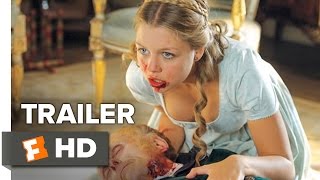
"It is a truth universally acknowledged that a zombie in possession of brains must be in want of more brains." In 19th century England, a zombie outbreak has ascended onto Jane Austen's classic tale relaying tangled relationships, class divides and gender inequity. Geared more towards Jane Austin fans and perhaps not as absorbing for hard core zombie aficionados; the 1813 novel has been reimagined to modernise its female role models for todays women. The updated Elizabeth Bennet is a master of martial arts and weaponry. Along with her four sisters, the Bennets beautiful costumes are adorned with thigh high slits to accommodate their ass kicking, over-the knee boots. In parts the film is pretty gruesome and is inflated with jump cuts, gross-out humour and experimental angles. The opening scene for instance includes a first person camera shot of a zombie slaying. Despite being an action film, it is the solid performances that pull the picture together. As the increasingly cleaver undead alongside a classic tale of securing appropriate suitor begins to trip itself up. After taking on the part of Disneys live action Cinderella, Lily James stars as Elizabeth Bennet with a deadpan emersions of the worlds that encase her. She has a believable and likable demeanour despite having to take on excessive amounts of dialogue direct from the Austen novel. It may be a one note joke but the tight shot, fast action and weapons stuffing garters sequences makes this film amusing. With a February release date and a distinct title, Pride and Prejudice and Zombies deliver exactly what the title promises.
- AL and AL Review
Incidents of Travel In The Multiverse The artists AL and AL are interpreting tarot cards, rewriting history and reuniting across the Multiverse in a new exhibit that partners’ science and spirituality. The three-part journey at HOME asks you to take a leap of faith while exploring notions of space-time and reality. Incidents of Travel in the Multiverse begin in The Drawing Room, where seven images drawn on music paper reflect the reimagined myth of Icarus. Instead of flying too close to the sun, the boy travels to the edge of a black hole. Alongside the film At The Edge Of Time, the reimagined Voyage of Icarus supposedly brings Einstein’s theory of general relativity to life. The exhibit is embedded with scientific theory, and the artist film is back with a vengeance. Seven screens are used to explore the mysteries of the universe; with extensive research, technologies and collaborations created to review the possibilities of phenomena beyond that which can be proven. The artist's newest work, The Demiurge, focuses on the origins of life were modified clones travel across the Multiverse to find a cure for death. Many pieces are dedicated to Alan Turning and a brief encounter he had with a tarot reading gypsy. The artists question what cards Turning selected in rooms set in the past (1954) and the future (2154) where the films display time traveling machines in search of Turning. Ultimately, the exhibit is best explained by a smaller sign that stands at the entrance of the exhibit. A neon sign is holding an equation that does not speak for itself. The shared knowledge of physicists and mathematicians that highlight The Secret Language of Truth. The artists AL and AL clearly understand these scientific theories but don't necessarily know how to relay that to the average viewer. If you didn't know what the future held before you entered Incidents of Travel in the Multiverse, be prepared to remain confused as the secret club is likely to remain a mystery. Sat 6 Feb 2016 – Sun 10 Apr 2016